Tuesday, July 18, 2017

Arkansas Educators Professional Development Workshop


Arkansas and World War II

"Professional Development"

June 20, 2017, educators from across the state came to central Arkansas for a workshop that explored the role Arkansas played during World War II.  There were five presenters that included Shane Lind, Anita Deason, Kim Sanders,  DannaKay Duggar, and Allison Hiblong.


The workshop began at the MacArthur Museum of Arkansas Military History with Shane Lind.  Mr. Lind highlighted the museum's Allison Collection of over 4,600 World War II photographs and original posters from the War Relief Program of the United States.  The posters are currently on display through October 5, 2017.

Col. (Ret.) Anita Deason, Military and Veterans Affairs Liaison for Senator John Boozman's Office, lead a session on The Library of Congress Veterans History Project.  Colonel Deason explained that the project is focused on collecting, preserving, and making accessible the personal accounts of American veterans.  To learn more about this project, click here.

The last session that morning was by Kim Sanders from The Butler Center of Arkansas Studies.  Ms. Sanders discussed the Japanese Americans who were forced to leave their homes and relocate to military camps during World War II.  16,000 men, women, and children were sent to camps at Jerome and Rohwer in southeast Arkansas.  The center's exhibit "The American Dream Deferred: Japanese American Incarceration in World War II Arkansas" is on display through July 29, 2017.


After lunch the workshop moved across the river to the Arkansas Inland Maritime Museum.  Here educators were taken through the museum to see two naval vessels that represent the bookends of World War II.  Allison Hiblong provided tours of the submarine USS Razorback as well as assistance in visiting the museum's exhibits.

DannaKay Duggar from the Jacksonville Museum of Military History portrayed Rosie the Riveter to explain the Salvage Collection Program the United States Government created for school children during World War II.  Ms. Duggar presents this interactive program to schools.  You can learn more about this program and the museum by clicking here.  

This was a very successful workshop and we plan on presenting a similar workshop in 2018.

Labels: , , , ,

Tuesday, December 15, 2015

Hoga's Saga

"Museum Updates"


Two thousand and fifteen was a big year for the Arkansas Inland Maritime Museum, the City of North Little Rock, the State of Arkansas, and to all who are interested in national history.  On July 28, 2005, the U.S. Navy officially transferred Hoga to the City of North Little Rock to be a permanent exhibit.  November 23, 2015, Hoga arrived at the Arkansas Inland Maritime Museum.  Why is this so important?

USS Hoga at sea trials, 1941.
Photograph courtesey of the United States Navy.
USS Hoga (YT 146)

The United States Navy yard tug Hoga is typical of hundreds of World War II-era naval service craft. This Woban Class District Harbor Tug was built in Morris Heights, New York, by the Consolidated Shipbuilding Corporation in 1940.  Hoga was placed into service with the U. S. Navy on May 22, 1941, and allocated to the 14th Naval District at the Naval Station in Pearl Harbor.


USS Hoga at the Pearl Harbor Attack

USS Hoga assisting USS Nevada on 12-07-1941.
Photograph courtesy of National Archives.
Hoga, is of exceptional significance in American history; Hoga is one of two known surviving yard craft present at Pearl Harbor during the Japanese attack on the U.S. Pacific Fleet on December 7, 1941.  While not engaged in combatting the enemy, the yard craft performed heroic service, fighting fires on burning battleships and other vessels in the harbor and rescuing wounded sailors from the oily waters of Battleship Row.

Hoga, particularly distinguished herself through her crew’s actions in helping beach the burning and sinking battleship USS Nevada at Hospital Point, as her run for the open sea was aborted by Japanese bombers intending to sink her in the channel and block access to Pearl Harbor. 

USS Hoga fighting fires on Battleship Row on 12-07-1941.
Photograph courtesy of National Archives.
Hoga also pushed the repair ship USS Vestal away from USS Arizona's burning hull and assisted the damaged minesweeper USS Oglala. In all, Hoga spent 72 continuous hours fighting fires on USS Maryland, USS Tennessee, USS Arizona and others.  Hoga, her commanding officer, and the crew received a commendation from Admiral Chester A. Nimitz, Commander in Chief of the Pacific Fleet.


USS Hoga during World War II

On December 7, 1941, eleven ships were sunk and nine ships were damaged in Pearl Harbor.  In the weeks following the attack, a great deal of repair work was done by the Pearl Harbor Navy Yard.  Hoga, her sister yard tugs, and support craft worked hard assisting in the salvage, refitting, and repairing of damaged vessels.

Despite the damage that had been done by the Japanese attack, Pearl Harbor remained an active naval base. The yard tugs, such as Hoga, moved ships in and out of Pearl Harbor throughout the war.

USS Hoga Serving the Port of Oakland

Port of Oakland, Oakland fireboat, 1957.
Photograph courtesy of Oakland Public Library.
In 1948, Hoga was transferred on loan to the Port of Oakland for use as a fireboat.  The re-christened Port of Oakland (later changed to City of Oakland) entered service in July 1948.  She was modified to increase her fire-fighting capability.  As an Oakland fireboat, the vessel combated numerous shipboard fires, waterfront blazes, and rescued persons in the water.  City of Oakland served as a tour boat for President Jimmy Carter during a 35-minute tour of the port on July 3, 1980. 


City of Oakland, Oakland fireboat, circa 1980.
Photograph courtesy of Oakland Fire Department.


Hoga received National Landmark Status on June 30, 1989, while still serving as the fireboat City of Oakland. After 45 years in the Oakland Fire Department, Hoga was returned to the United States Navy in 1994.  From there she was moved to the Maritime Administration’s Suisan Bay Reserve Fleet.  Hoga was stricken from the Naval Vessel Register in 1996.


USS Hoga Restoration

USS Hoga 2012.

Restoration work was performed on Hoga between 2012 and 2014, while docked at Mare Island Ship Yard, Vallejo, California.  Major repairs were made to Hoga’s hull and boat deck to ensure water tight integrity.  Firefighting equipment and non-original external piping added during the 1948 refit was removed.  Old paint was removed by hydro-blasting, and Hoga was re-painted; restoring the ship, as close as possible, to her original appearance.  

USS Hoga 2014.

USS Hoga’s Journey to North Little Rock

USS Hoga's transport from San Francisco to San Diego.
Video courtesy of Patrick Hays.


Hoga was towed from San Francisco to San Diego by the tug A. N. Tillett from Pacific Tugboat Service on September 25, 2015.  Then on October 1, 2015, Tillett transported Hoga to Ensenada, Mexico.  


USS Hoga being heavy lifted by Peters and May.

USS Hoga transported through the Panama Canal.
Once in Ensenada a boat transport company, Peters and May Global Marine Transport, agreed to carry Hoga to the gulf. Thorco Isadora, a carrier ship, lifted Hoga onto its deck and carried the little tug from Ensenada to the gulf, traveling through the Panama Canal on October 15, 2015. 

Thorco Isadora stopped in Fort Lauderdale to drop off cargo, was delayed in New Orleans, and then offloaded Hoga in Houston on November 7, 2015. 


USS Hoga on the Arkansas River.
Photograph courtesy of James D. Hayes.
 Hard’s Marine Service used their tug, Martha Renae, to move Hoga from Houston to New Orleans from November 11-13, 2015.  The Pine Bluff Sand and Gravel Company transported Hoga up the Mississippi River on November 17, 2015, with their tug Jake West.  Once in the Arkansas River, Bruce Oakley Inc.’s subsidiary Jantran Inc. moved Hoga into North Little Rock with their tug Brother Wilson on November 23, 2015.
USS Hoga arriving at the Arkansas Inland Maritime Museum.


USS Hoga's Ceremony
North Little Rock Police Honor Guard.
Photograph courtesy of John Barr.

On December 7, 2015, the Arkansas Inland Maritime Museum along with the Arkansas’s Secretary of State’s Office held the Pearl Harbor Survivor Ceremony.  To honor the 74th Anniversary of the attack on Pearl Harbor, the State of Arkansas honored the last three surviving Arkansas Pearl Harbor survivors. 
Three Arkansas Pearl Harbor Survivors.
Photograph courtesy of John Barr.

Vic Snyder, AIMM Board Member.
Photograph courtesy of John Barr.
North Little Rock Police Bugler.
Photograph courtesy of John Barr.


The ceremony was emceed by AIMM Board member Vic Snyder.  The North Little Rock Police Department Honor Guard posted the colors and provided a bugler player for the event.  Boy Scout Troop #198 from Mabelvale, Arkansas, lead the audience in the Pledge of Allegiance.  


North Little Rock Community Concert Band.
Photograph courtesy of John Barr.


The North Little Rock Community Concert Band, directed by Ricco Belotti, volunteered their talents to perform the National Anthem and Arkansas Pearl Harbor Survivor March.  The Two Bell Ceremony in honor of those who served on December 7, 1941, was performed by the Fleet Reserve Association.  


Susan Hutchinson, First Lady of Arkansas.  Photograph courtesy of John Barr.
Speakers for the ceremony included First Lady of Arkansas Susan Hutchinson, Secretary of State Mark Martin, Mayor of North Little Rock Joe Smith, as well as AIMM Board members Patrick Hays and Major General Don Morrow.  

Secretary of State Mark Martin.  Photograph courtesy of John Barr.
Mayor Joe Smith, City of North Little Rock.
Photograph courtesy of John Barr.
Patrick Hays, AIMM Board Member.
Photograph courtesy of John Barr.
Major General Don Morrow, AIMM Board President.
Photograph courtesy of John Barr.

Ribbon Cutting to officially open USS Hoga for public viewing.
Photograph courtesy of John Barr.


The ceremony concluded with the North Little Rock Chamber of Commerce’s Ribbon Cutting.


Photograph courtesy of John Barr.


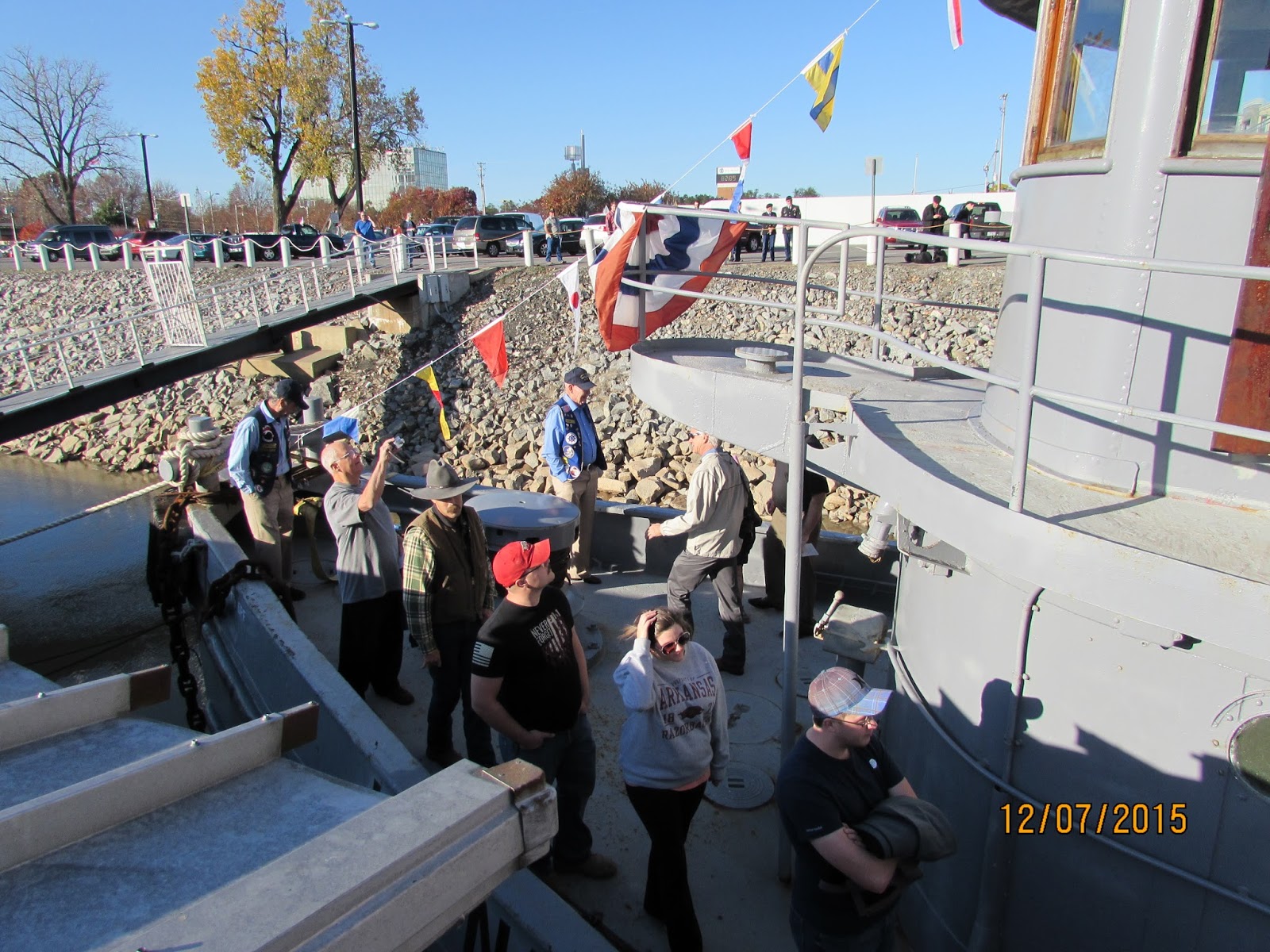
Following the Pearl Harbor Survivor ceremony, the Arkansas Inland Maritime Museum hosted a free day to board the main deck of USS Hoga.  


Photograph courtesy of John Barr.


The USSVI Razorback Base, which consists of submarine veterans from Central Arkansas, volunteered to assist the general public aboard USS Hoga.

Photograph courtesy of John Barr.

Refreshments following the ceremony were provided by the United Daughters of the Confederacy, United States Daughters of 1812 and Colonial Dames of the 17th Century.

Finally, the Arkansas Inland Maritime Museum board and staff want to give a big THANKS to all donors and supporters who were committed in bringing USS Hoga to Arkansas.

The next step is to move Hoga further up the Arkansas River to her permanent mooring location at the Arkansas Inland Maritime Museum.  We are expecting this to happen at the beginning of 2016.  Once she is put into place, preservation work will continue on the boat's interior.  Preservation work is going to be completed based on EPA and historic preservation standards.  The museum is continuing to collect donations to complete the interior work that Hoga requires to become available to the general public.  

Support is welcomed through volunteer efforts and financial contributions.  Those interested in volunteering at the museum are asked to come by the museum and fill out a volunteer application.  The application will be forwarded to our Maintenance Chief at the museum.  Financial contributions can be made in many different ways: 
  1. In person during the museum's operating hours. http://aimmuseum.org/hours-admission/
  2. A check made out to Arkansas Inland Maritime Museum designated for USS Hoga mailed to 120 Riverfront Park Drive, North Little Rock 72114.
  3. Paypal via the museum's website.  http://aimmuseum.org/donate/
  4. Go Fund Me "Save the Hoga" account.  https://www.gofundme.com/zsbwqtys
Once Hoga is opened to the public, the State of Arkansas will have the only place in the world where visitors can walk aboard a Navy vessel that served in Pearl Harbor on December 7, 1941, and a Navy vessel that was at the formal surrender of the Empire of Japan on September 2, 1945.  

Stay tuned for more updates!!


Labels: , , , , , , , ,

Wednesday, September 02, 2015

Benny's Peacemakers

"Submarine Honor Guard"

"Benny's Peacemakers"

“Cease offensive operations against Japanese forces.  Continue search and patrols.  Maintain defensive and internal security measures at highest level and beware of treachery or last moment attacks by enemy forces or individuals.” –Admiral Chester W. Nimitz, Chief of Naval Operations, August 14, 1945.

This message was sent to all United States naval units in the Pacific Fleet.  The commander of the Submarine Force Pacific Fleet, Admiral Charles A. Lockwood, then relayed the message to his submarines.

Excerpt from the diary of USS Razorback (SS 394) crew member Atkinson.  AIMM Permanent Collection.


August 30, 1945, twelve United States Navy submarines rendezvoused with task group “Benny’s Peacemakers” to participate in the formal surrender of the Empire of Japan in Tokyo Bay, Japan.

"Benny" referred to Commander Raymond Henry "Benny" Bass.  Bass, a native Arkansan, graduated from the Naval Academy in 1931 and served in the United States Navy until 1959.  During World War II, Bass was a submarine commander throughout the war.  When the “Cease Fire” was given, Commander Bass commanded the submarine USS Runner (SS 476).  He was put in command of twelve submarines, “Benny’s Peacemakers,” to witness the end of World War II.

Excerpt from the diary of USS Razorback (SS 394) crew member Atkinson.  AIMM Permanent Collection.

“Benny’s Peacemakers” tied up alongside the submarine tender USS Proteus (AS 19) on August 31, 1945.


Proteus was commissioned into the United States Navy on January 31, 1944.  She served in Midway and Guam completing voyage repairs and refitted submarines.  Proteus became the flagship of a twenty six ship support group that steamed off the coast of Honshu, Japan, until August 26, 1945.  Two days later, the submarine tender anchored in Sagami Wan to support submarines.  August 31, 1945, Proteus and “Benny’s Peacemakers” anchored off Yokosuka Navy Yard, in Yokosuka Ko, Japan.

Excerpt from USS Razorback (SS 394) September 1945 deck log.  

USS Razorback (SS 394) crew members listening to the live broadcast of the surrender ceremony.  Raines's photograph collection.  AIMM permanent collection.


The ceremony began at 9:02 a.m. on September 2, 1945. The ceremony was broadcast throughout the world and lasted twenty three minutes.  The ceremony ended with the following statement.

"Let us pray that peace be now restored to the world and that God will preserve it always. These proceedings are closed!" -  General MacArthur, September 2, 1945.

With those words the Second Great War was finally over.

"Admiral Lockwood returning from formal surrender on the Missouri.  He is Chief of all subs operating in Pacific area." -- Marion Raines.  Raines's photograph aboard USS Razorback (SS 394) September 2, 1945.  AIMM permanent collection.

Author: Allison Hiblong

Labels: , , , , , , , , , ,

Monday, August 24, 2015

USS Muskallunge (SS 262)

"Submarine Honor Guard"

USS Muskallunge (SS 262)

The Gato-class submarine, USS Muskallunge (SS 262) was built by the Electric Boat Company in 1942.  She was commissioned into the United States Navy on March 15, 1943.  Muskallunge entered the war in September of 1943 with the Pacific Fleet.  She completed seven war patrols during World War II.
USS Muskallunge (SS 262) on September 4, 1943. United States Navy photograph.

 Muskallunge's last war patrol was spent in the Kurile Islands, north of Japan, attacking Japanese ships.  On August 8, 1945, enemy fire killed one of the submarine's gunners and wounded two other crew members.  With the news of victory on August 15, Muskallunge received orders to report to Tokyo Bay for the formal surrender ceremonies on September 2, 1945.


USS Muskallunge's (SS 262) World War II battle flag.  United States Navy photograph.

September 3, 1945, Muskallunge was sent to the Atlantic Fleet where she served until she was decommissioned on January 29, 1947.

Muskallunge was recommissioned on August 31, 1956, prior to being transferred to Brazil.  The transfer took place on January 18, 1957.  Muskallunge was on loan to Brazil and served the Brazilian Navy as Humaitá (S14).  

Humaitá (S14), October 1966, transferring cargo.  Brazilian Navy photograph.

March of 1968, the submarine was returned to the United States and was sunk as a target off Long Island, New York, on July 9, 1968.  During Muskallunge's 25 years of existence, she served actively for four years, 4 months, 1 day with the United States Navy and eleven years, 5 months, and 21 days with the Brazilian Navy.  

Labels: , , , , , , ,

Friday, August 21, 2015

USS Hake (SS 256)

"Submarine Honor Guard"

USS Hake (SS 256)


Postal cover to commemorate USS Hake's (SS 256) commissioning, October 30, 1942.  Courtesy of Jack Treutle.

USS Hake's (SS 256) keel was laid November 1, 1941, in Groton, Connecticut.  The Electric Boat Company launched the boat on July 17, 1942 and commissioned her three and a half months later on October 30, 1942.
USS Hake (SS 256) November 1943.  United States Navy photograph.

Hake's first two war patrols were in the Atlantic Fleet on antisubmarine patrol.  From April 3, 1943 through July 17, 1943, her mission was to search and destroy German submarines in the North Atlantic.  She did encounter a few submarines but did not have any kills during these patrols.
USS Hake (SS 256) November 1943.  United States Navy photograph.

The rest of the war, Hake spent in the Pacific Fleet.  She completed seven more war patrols totaling nine war patrols.  During that time she served off the Philippine Islands, Luzon, Mindanao, South China Sea, Mariana Islands, and Panay Island.  Hake witnessed the loss of USS Harder (SS 257) and USS Growler (SS 215).  In November of 1944, the submarine was sent on a special mission to pick up 29 United States aviators that were held by the Filipino guerrillas.  Hake successfully transported these aviators to Australia before she continued on with her war patrols.
USS Hake's (SS 256) officers on deck September 2, 1945.
From left to right: Fred Maier, Lt. jg Ted Snyder, Lt. Charlie Knapp, Lt. Bob Heysinger, CDR Frank Haylor, LCDR Jack Edmands, Lt. jg Dick Metzger.  Photograph courtesy of Henry (Hank) Knebes.

Hake's ninth war patrol began on July 20, 1945.  She served on lifeguard duty for the air strikes on Japan until the surrender was announced.  Hake was one of the twelve submarines that was given the distinction of being able to witness the formal surrender ceremonies in Tokyo Bay on September 2, 1945.
USS Hake (SS 256) battle flag.  
Post World War II, Hake returned to New London, Connecticut, and was decommissioned on July 13, 1946.  Ten years later, October 15, 1956, Hake was chosen to serve the Navy as a reserve training ship in Philadelphia, Pennsylvania.  Her classification was changed to an auxiliary submarine, AGSS 256.  Hake served as a reserve training ship until November 6, 1962.  The submarine was struck from the Naval Register on March 1, 1967 and sold for scrap on December 5, 1972.
USS Hake (SS 256) circa 1960s.  United States Navy photograph.

Hake actively served the United States Navy for three years, nine months, and fourteen days earning seven battle stars during her service in World War II.  The submarine then served the Navy as a training ship for six years and twenty-two days.

Author: Allison Hiblong

Labels: , , , , , , , , , , ,

Wednesday, August 19, 2015

USS Gato (SS 212)

"Submarine Honor Guard"

USS Gato (SS 212)
Line drawing of USS Gato (SS 212).  Drawing courtesy of Thomas F. Walkowiak.

USS Gato (SS 212) was the lead boat of her class.  Gato-class submarines were launched from 1941 to 1943 and were the first mass production United States submarine class produced in World War II.

USS Gato (SS 212) December 31, 1941.  United States Navy photograph.

The Electric Boat Company laid Gato's keel on October 5, 1940.  She was launched in Groton, Connecticut, on August 21, 1941, and was commissioned into the United States Navy December 31, 1941.  Her first war patrol began in the Pacific on April 20, 1942.

During World War II, Gato completed thirteen war patrols.  Her first five patrols she served off the coast of the Marshall Islands, Kurile Islands, Kiska, Truk atoll, Solomon Islands, and Gilbert Islands. Then during the summer of 1943, Gato was assigned to Mare Island Naval Shipyard for overhaul. 

Pen and ink drawing of USS Gato (SS 212) at Mare Island.  United State Navy photograph.

War patrols six through ten, Gato served in the Salomons, Bismark Archipelago, Milne Bay, Majuro atoll, and Chichi Jima. During her ninth war patrol she transported Vice Admiral Charles A. Lockwood from Pearl Harbor to Midway in June of 1944.  After the tenth war patrol, Gato again returned to Mare Island for another overhaul.
USS Gato (SS 212) 4"/50 cal deck gun during November 1944 overhaul. United States Navy photograph.
The modifications made to Gato, included installation of new freestanding mast for SD radar and relocation of SJ to a new mast supported by her periscope shears.   January 1945, Gato returned to war for her eleventh patrol.  The rest of the war she patrolled the Yellow Sea, off the coat of Okinawa, and the coast of Wake Island.  While serving lifeguard duty during air strikes on Wake Island, "Cease Fire" was received aboard the submarine.  Gato was able to be apart of the formal surrender ceremony by the Empire of Japan on September 2, 1945.


November 1944 modifications made in Mare Island.  Photograph courtesy of Norman Friedman.
After World War II, Gato was sent to the New York Naval Shipyard.  She was decommissioned on March 16, 1946.  She did serve as a Naval Reserve training ship at New York and Baltimore, Maryland.  March 1, 1960, her name was stricken from the Naval Register.  The Northern Metals Company of Philadelphia, Pennsylvania, bought Gato for scrapping on July 25, 1960.

Gato actively served  in the United States Navy for four years, 3 months, and 16 days.  During that time she earned 13 battle stars and Presidential Unit Citation for her service in World War II.

An American syndicated anthology television series, The Silent Service, aired from 1957 to 1958. This series was based on actual events about submarine service in the United States Navy.  The series finale focused on the service of Gato.  The episode "Five Ring Circus" tells the story of when a Japanese depth charge landed on the deck of the boat without exploding.  The episode can be viewed on Youtube at https://www.youtube.com/watch?v=ngb5_JChxac.

Author: Allison Hiblong

Labels: , , , , , , , , , , ,