Saturday, December 19, 2009

Submarine in the Fog


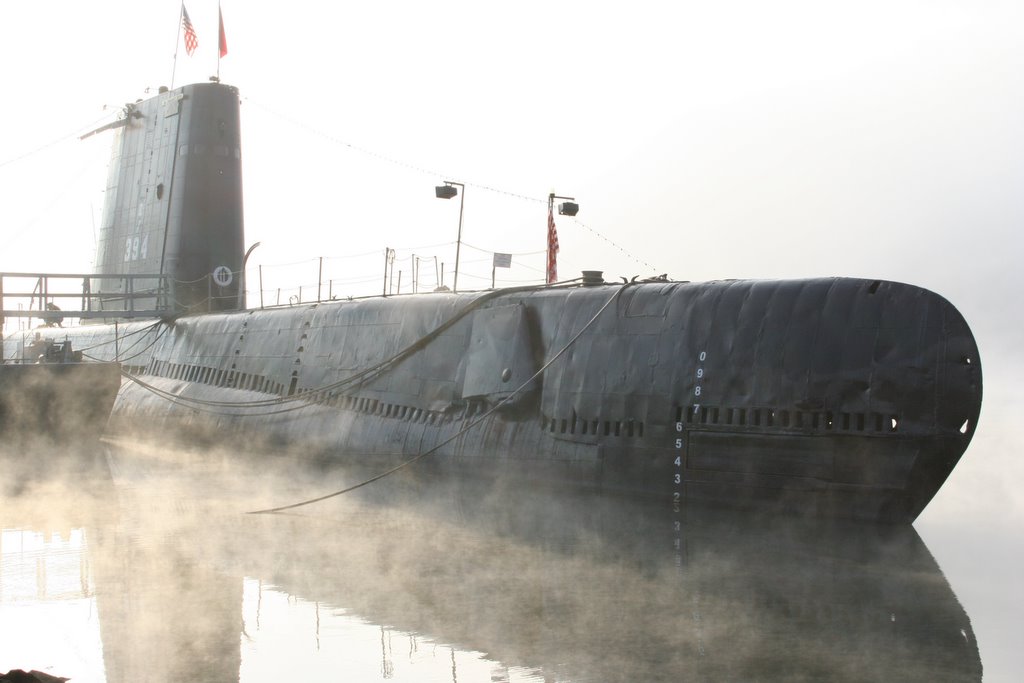
In 2005 one of AIMM's many volunteer photographers arrived at the submarine early in the morning.

The river was shrouded in fog, completely hiding the southern bank, and making Razorback appear as if she was all alone on the river.

A Naval Hero From Arkansas


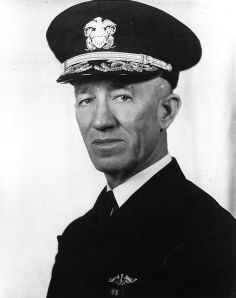
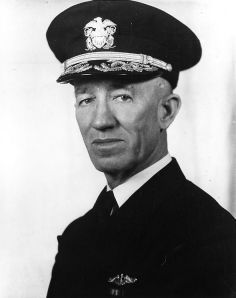
Today is the birthday of Admiral Charles Maynard "Savvy" Cooke, Jr.

Admiral Cooke was born in Fort Smith on 19 December, 1886. He graduated from the University of Arkansas in only two years while also working full time on local road repair crews.

He entered the US Naval Academy in Annapolis, MD, where he graduated second in the Class of 1910, earning the nickname "Savvy". According to his classmates, the nickname reflected Midshipman Cooke's common sense and practicality as much as his academic billiance.

As was the tradition of the day, he was not immediately commissioned, but instead served on various ships, including the battleships USS Connecticut, USS Maine, and USS Alabama. During this time he met, courted, and married Helena Leslie Temple, the daughter of a prominent family from Philadelphia.

On 17 November, 1913, then Ensign Cooke reported to submarine school, then held in New York Harbor aboard USS Tonopah, an ironclad monitor, long since removed from front line service and pressed into duty as a floating classroom.

Picked for early promotion during his submarine training, Savvy Cooke first reported for duty as the Executive Officer of the submarine K-2. Less than a month later, he became Commanding Officer of USS E-2, after that's submarine's CO was severely injured in an accident. Seawater entered the battery well of E-2 sending deadly chlorine gas throughout the small submarine.

Just a few months after assuming command of E-2, then LT(jg) Cooke was in New York harbor, on the deck of his former school ship Tonopah, when he saw the wake of a passing boat swamp a small canoe. The two teen-aged boys in the canoe were swept overboard, into the frigid waters of the harbor. One boy was trapped under the overturned canoe. Without hesitation, Savvy lept into the water, risking his own life to save both boys.

Savvy's courage would be tested again on 16 January, 1916 when experimental batteries installed aboard E-2 exploded, killing four men outright and injuring ten, one of whom would later succumb to his injuries. At the time of the explosion, Savvy was aboard the nearby submarine tender USS Ozark (the former monitor USS Arkansas). He immediately rushed to his stricken submarine, and led a group of men inside to rescue his injured crewmen, despite the obvious dangers.

Savvy Cooke and his crew were completed absolved of blame in the accident. Despite this, he spent the next two years in shore duty assignments.

In December 1918, a newly promoted LCDR Cooke was assigned to the outfitting of USS R-2, a submarine then still being built. His mother christened R-2 and Savvy became her first CO when she was commissioned on 24 January, 1919.

He repeated the process for the larger submarine S-5. When S-5 sank on 01 September, 1920 while in transit from Boston to Baltimore, Savvy Cooke was able to lead his crew on a successful escape from the sunken submarine.

With her bow stuck in the mud, S-5's after ballast tanks were blown, bringing her stern just above the water. Even though the decks were nearly vertical, and they only had hand tools (their one electric drill failed after a short time), S-5's crew was able to cut a small triangular hole, six inches wide by eight inches tall through the 3/4" thick steel hull. The crew was able to attract the attention of a passing freighter, the steamer Alanthus. With the help of the crew from the Alanthus and another passing ship, the passenger steamer General George W. Goethals, the small hole was enlarged enough to allow every man from S-5's crew to escape.

The plate cut from S-5's hull is on display in the US Navy Museum in the Washington Navy Yard:
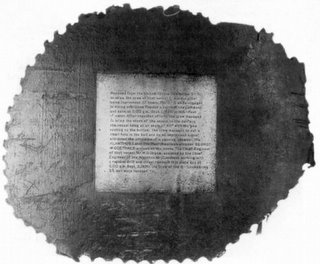

(From the book Under Pressure: The Final Voyage of Submarine S-Five by A.J. Hill)

The straight edge on the right side of the plate is one side of the hole cut by S-5's crew.

Following the S-5 disaster, Savvy Cooke's career continued to advance. He served in a succession of increasingly important assignments, both ashore and at sea, then was assigned as Commanding Officer of the battleship USS Pennsylvania in February, 1941. Captain Cooke had remarried following the tragic death of his first wife. Although his family had usually accompanied him, in 1941 Captain Cooke sent them to California because he believed war was coming.

"Savvy" Cooke was right.

Surviving the Japanese attack on Pearl Harbor, Captain Cooke oversaw the repair of his ship, but was transferred to the Navy's Strategic Planning Division in Washington, DC when Pennsylvania was ready to return to battle. Quickly promoted to Rear Admiral, by 1945 he had been promoted again to Vice Admiral, was head of Strategic Planning for the entire Navy, and was the principal adviser to Admiral King, Chief of Naval Operations.

Savvy Cooke still saw his share of action. He was present at the Normandy Invasion and went ashore at noon on D-Day.

Although he almost certainly would have been an outstanding fleet commander during the war, it was believed that he performed a far more valuable service in his role in Strategic Planning. One of his contemporaries said that of all those unsung heroes who helped win WWII, Savvy Cooke's name "stands out at the top".

After the war, Admiral Cooke spent two years in China, trying unsuccessfully to bolster support for the Chinese Nationalists. He then served as Commander, Seventh Fleet, retiring in early May, 1948.

Admiral Charles M. Cooke, Jr died on 24 December 1970. He is buried in Arlington National Cemetery.

(Sources: Under Pressure: The Final Voyage of Submarine S-Five by A.J. Hill and the US Naval Historical Center)
Thursday, December 17, 2009

In Memoriam - USS F-1 (SS-20) - Sunk 17 December 1917


On the morning of 17 December, 1917, USS F-1 (SS-20), along with her sister ships F-2 (SS-21) and F-2 (SS-22), got underway for an engineering test. The plan was to steam south from San Pedro to Point Loma, then return. The submarines, designed in the early 1900s and commissioned in 1912 could only make 10 knots on the surface. The round trip was scheduled to take about eight hours.

Since heavy fog is common off the California coast in winter, the plan for the engineering test included a contingency plan for the three submarines to turn to seaward if they ran into poor visibility.

F-1 was closest to the shore, with the other two submarines to her west.

About 1830, the three submarines encountered the expected thick fog. F-1 turned slightly west and sent a radio message to the other two submarines reporting her course change. Unfortunately, this message was not received by the other two boats. F-3 continued on her course south, and F-1 passed behind her, unseen.

At 1904, F-3 began turning to starboard with the plan of reversing course to the north to quickly exit the fog bank.

Eight minutes later, F-1's lights were spotted. The two submarines were on a collision course with a combined speed of nearly 20 knots.

Despite last minute maneuvers by both submarines, F-3 struck F-1 at nearly a right angle, near the bulkhead between the control room and the engine room.

The four men on F-1's makeshift bridge were thrown into the water. A fifth man manged to climb out of the control room, but he was the only one to get out of the doomed submarine.

Nineteen men perished in the accident.


In October, 1975, USNS De Steiguer (T-AGOR-12), an oceanographic research ship, located in 635 feet of water. The hull is laying on its starboard side, with the hole made by F-3 clearly visible.

Photographs courtesy of the U.S. Naval Historical Center.

In Memoriam - USS S-4 (SS-109) - Lost 17 December 1927


USS S-4 (SS-109) sank on 17 December 1927 after being accidentally rammed by the U.S. Coast Guard Cutter Paulding during tests off the New England coast.

Originally commissioned in 1919, in 1920-21, S-4 made a historic voyage from New London, CT through the Panama Canal, to Pearl Harbor and on to Cavite, Philippines. At the time, it was the longest voyage ever undertaken by an American submarine. S-4 traveled as far as the coast of China during her tenure in the Far East.

In 1925, S-4 was reassigned to the West Coast and she returned to the Portsmouth Naval Shipyard, where she had been built, in early 1927 for dry docking, maintenance, and modernization.

Following the refit, S-4 put to sea for the normal series of post-dry docking tests, escorted by a US Coast Guard cutter, Paulding.

During these tests, tragedy struck.

After completing a submerged run at full speed, S-4 began to surface. The Coast Guard cutter was not equipped with sonar, and her crew misjudged their position in relation to the submerged submarine.

The Coast Guard Cutter's crew spotted the submarine's periscopes, but not in time to prevent the collision. S-4 was struck in her Battery Compartment, which was forward of the Control Room and Conning Tower. Part of the Coast Guard Cutter's bow broke off inside S-4.

The submarine's entire crew survived the initial accident. Men in the Battery Compartment tried in vain to stop the flooding, but had to quickly retreat to the Control Room, then to the Engine Room as flooding progressed. Six men were trapped in the Forward Torpedo Room, the remaining 28 men were trapped aft, in the Engine Room and Motor Room.

The submarine settled to the bottom in 110' of water.

By the time divers arrived on the scene, the men in the after compartments had already succumbed to the combination of cold, chlorine gas, and falling oxygen levels, but the six men in the forward torpedo room were still alive and were able to communicate with the divers on the outside by tapping on the hull.

Unfortunately, S-4 was not designed with a forward torpedo room escape trunk and by the time air lines and special fittings could be hooked up, the CO2 level had risen to 7%, far too high to support human life.

The failure to rescue S-4's crew raised a very public outcry and forced the Navy to being exploring means of both submarine escape and submarine rescue, ultimately leading to the development of the Momsen escape lung and the Momsen-McCann Diving Bell.

The successors of both of these devices are still in use today. American submarines now carry the SEIE, or Submarine Escape and Immersion Equipment, a full-body suit that allows escape from a submarine at 600', or almost six times deeper than S-4.

The Momsen-McCann Diving Bell has become a host of submarine rescue equipment, including the Submarine Rescue Chamber, as well as specialized, self-propelled rescue submarines.

While the loss of men aboard S-4 was tragic, they did not die in vain.

Photograph courtesy of the U.S. Naval Historical Center.

Thursday, December 10, 2009

In Memoriam - USS Sealion (SS-195) - Sunk 10 December 1941


The first American submarine to fall victim to a Japanese attack was USS Sealion (SS-195). The start of World War II found her, along with her sister ship, USS Seadragon (SS-194) in the final stages of an extensive overhaul at the Cavite Navy Yard, Philippines. The two submarines were moored side-by-side.

On the afternoon of 10 December, a group of 54 Japanese planes attacked the shipyard.

Only two Japanese bombs actually struck Sealion. The first exploded outside the conning tower. In addition to destroying a machine gun mount on Sealion, a fragment from this bomb pierced Seadragon's conning tower, killing one officer.

A second bomb struck Sealion aft, penetrating the pressure hull and entering the after engine room, where it exploded, killing four men.

Damage from the explosion and resulting flooding was extensive. All motor controls, reduction gears and main motors were destroyed. Sealion was completely immobilized.

Unfortunately, the Cavite Navy Yard was nearly completely destroyed by the same Japanese attack, and repairs were impossible. Nor was it practical to tow the submarine some 5,000 miles to Pearl Harbor, the nearest working repair facility.

All valuable gear such as gyroscopes, radios and sonar equipment was removed from the crippled submarine.

On Christmas Day, 1941, three depth charges were exploded inside Sealion's hull to prevent her from being used by the enemy.

Thursday, November 19, 2009

New Photographs Added to the Website


"Gene" J. Haley, Sr., served aboard USS Razorback from 1945 until 1948. He generously donated a personal collection of photographs to the museum. Many of these photographs have been on display in the museum or have been used in our videos, but we recently realized that the entire collection had never been put on the AIMM website.


There are over 40 photographs in the collection.

The entire collection can been seen at:

http://www.aimm.museum/photos-SS394-6-1945-48-Gene_Haley.asp

The entire photograph section has been re-organized, and many new photographs have been added.

Due to space limitations, only medium-quality images have been uploaded to the website. However, in most cases, a high-quality image is available upon request.

Monday, November 16, 2009

In Memoriam - USS Corvina (SS-226) - Sunk 16 November 1943


USS Corvina (SS-226) was lost on her very first war patrol.

She had been commissioned 06 August, 1943. After her initial shakedown, she transited the Panama Canal and crossed the Pacific to the submarine base at Pearl Harbor, HI. Corvina left Pearl Harbor on 04 November. Her mission was to patrol the Japanese stronghold of Truk, the empire's main base in the South Pacific.

A large part of the Japanese surface fleet was stationed at Truk and Corvina's mission was to intercept any Japanese warships that might leave the base in response to the American attack on the Gilbert Islands.

Corvina was never heard from again.

After the war, an examination of Japanese records revealed that on 16 November, 1943, the Japanese submarine I-176 spotted an American submarine on the surface and fired three torpedoes. Two of the torpedoes hit, causing "a great explosion sound."

I-176 would later be sunk by American forces in May 1944.

Saturday, November 07, 2009

In Memoriam - USS Albacore (SS-281) Sunk 07 November 1944


During her 11th war patrol, USS Albacore (SS-281) struck a Japanese mine while submerged and sank with the loss of all aboard.

The explosion was witnessed by a Japanese patrol craft which reported seeing a great amount of air bubles and heavy oil on the surface, as well as finding cork, bedding and various provisions afterward.


During her first 10 war patrols, Albacore rang up an impressive score:
  • Aircraft Carrier Taiho
  • Light Cruiser Tenryu
  • Destroyer Oshio
  • Destroyer Sazanami
  • An escort vessel
  • A large patrol boat
  • Six Freighters
  • Two Tankers
  • Two Transports
She was also awarded the Presidential Unit Citation four times.

Thursday, November 05, 2009

New Navy History in the AIMM Archives


A recruiting brochure from World War II has been donated to the museum.

"What Kind of Job Can I Get in the Navy?" is from 1942, just a few months after the United States entered the war. In addition to describing general Navy pay and benefits, this brochure describes 49 different specific career fields, describing pay and duties for each rating as well as related civilian jobs and general knowledge that would help an enlistee qualify for that rating.

Many of these ratings no longer exist at all, and many others only exist in greatly changed form, so this booklet provides a look back into our past.

Digital copies of this booklet are available upon request.

Wednesday, October 28, 2009

USS O-5 (SS-66) Sunk October 28, 1923


One of the U.S. Navy's earliest submarines, USS O-5 (SS-66) sank on October 23rd, 1923, less than a minute after being involved in a collision with the steamship SS Abangarez.

Most of the crew was able to escape the sinking submarine. One man, TM2 Henry Breault, reached the deck and realized the submarine was doomed. He also knew that a friend was still trapped in the torpedo room below. Instead of saving his own life, TM2 Breault returned below and secured the torpedo room hatches. Both men remained trapped aboard the submarine for 31 hours, until nearby cranes could be used to lift the stricken submarine enough for the men to be rescued.

TM2 Breault was awarded the Medal of Honor for his actions, the first Submariner to receive this award. He is also the only enlisted submariner to receive the Medal of Honor.

O-5 was salvaged shortly after her loss, but the damage was was too severe for her to be ec0nomically repaired, and she was sold for scrapping in December 1924.

Following a lengthy court case, the fault was placed on the submarine, not the merchant ship for the collision.

For more information about the loss of USS O-5, please visit "Submarine Hero: TM2 Henry Breault"

Monday, October 26, 2009

Winter / Holiday Hours Announced

The Arkansas Inland Maritime Museum will be open on the following schedule:

Starting Sunday, November 1st, with the return to Standard Time, we will begin closing at dusk, with the last tour starting 30 minutes prior to closing. (On the 1st, sunset is at 5:15 p.m.) We make this change each year for safety reasons.

Winter Hours
Friday - 10:00 a.m. to Dusk
Saturday - 10:00 a.m. to Dusk
Sunday - 1:00 p.m. to Dusk
We will return to Spring Hours in March, when Daylight Savings Time returns.

Thanksgiving Holiday
We will be open regular hours over the Thanksgiving Weekend:
Friday - 10:00 a.m. to Dusk
Saturday - 10:00 a.m. to Dusk
Sunday - 1:00 p.m. to Dusk
Christmast Holiday
Since Christmas falls on a Friday this year, we will be closed Christmas Day, in order to allow our employees to spend the holiday with their families. However, we will be open regular hours on Saturday and Sunday:
Saturday - 10:00 a.m. to Dusk
Sunday - 1:00 p.m. to Dusk
New Years Weekend
We will be closed on New Years Day, but open regular hours on Saturday and Sunday:
Saturday - 10:00 a.m. to Dusk
Sunday - 1:00 p.m. to Dusk
If you have any questions, or would like to book a group tour, birthday party, or overnight event, please contact the musuem at 501-371-8320.

Saturday, October 24, 2009

In Memoriam - USS Darter (SS-227) - Grounded October 24, 1944


USS Darter (SS-227) grounded on Bombay Shoal at high speed while attempting a surface attack on the Japanese heavy cruiser Takao.

Darter had already made a significant contribution to the Battle for Leyte Gulf, sinking Admiral Kurita's flagship, the heavy cruiser Atago and damaging Takao. The damage to the latter was so severe that she turned back and did not participate in the Battle of Leyte Gulf. In fact, Takao would never sail again as a warship. The loss of the two cruisers and the two destroyers tasked to escort Takao diminished the Japanese defenses and made the remaining ships more vulnerable, probably resulting in additional Japanese losses during the battle.

USS Dace, with whom she had been coordinating her attacks, responded immediately to the Darter's request for assistance, retrieving every member of her stranded crew. Darter and Dace's crews destroyed confidential equipment and papers before an unsuccessful attempt to destroy the boat herself. USS Nautilus (SS-168) arrived on October 31 and scored a number of hits with her deck guns on her grounded sister before her C.O. decided nothing of value could have survived the barrage intact.

Darter's fourth and final war patrol, served alongside Dace, won the two submarines the Navy Unit Commendation for their efforts during the Battle of Surigao Strait.

Darter's entire crew was ordered to take over the USS Menhaden (SS-377), in order to preserve their high esprit d'corps.

In Memoriam - USS Shark (SS-314) - Sunk 24 October, 1944


USS Shark (SS-314) and all of her crew were lost during their third war patrol, October 24, 1944, after a successful attack on a freighter. Her last message, received by the crew of the USS Seadragon (SS-194), indicated her C.O.'s decision to attack; a dispatch from Commander Naval Unit, Fourteenth Air Force, stated that a Japanese ship carrying nearly 2000 American prisoners of war had been sunk on October 24 by an American submarine.

Japanese records on anti-submarine warfare, obtained after the war, also mention the attack on the Japanese ship. The reports add that a Japanese destroyer, Harukaze, made contact with a submerged submarine in the same vicinity and pummeled it with seventeen depth charges. The same report mentions the surfacing of "oil, clothes, and other debris". This seems to be the most likely explanation for Shark's disappearance.

Shark had served her first patrol near the Mariana Islands as part of a coordinated attack group, working alongside Pintado (SS-387) and Pilotfish (SS-3860). This patrol proved productive; she sank two cargo ships, a passenger-cargo ship, and a freighter. Her second war patrol, served off the Volcano and Bonin Islands. Much of this patrol she served lifeguard station; she rescued two airmen from a downed topedo bomber, Lexington (CV-16). She was awarded one battle star for her efforts during World War II.

Shark was the second submarine of the same name to be lost during World War II. USS Shark (SS-174) was reported overdue and presumed lost on March 7th, 1942

In Memoriam - USS Tang (SS-306) - Sunk 24 October 1944


USS Tang (SS-306) was sunk while on her fifth war patrol, during an intense attack on a Japanese convoy. After sinking a destroyer and a tanker and damaging a transport, Tang closed on the transport, intending to sink her with the last two torpedoes remaining on board (the 23rd and 24th to be fired by Tang on this war patrol). The 23rd torpedo ran "hot, straight, and normal", however when the 24th torpedo was fired, it was observed to broach the ocean's surface and begin turning to the left in a "circular run".

Despite all attempts to escape the torpedo, Tang was struck at the aft torpedo room.

The explosion violently shook Tang, causing severe injuries as far forward as the Control Room.

Tang san by the stern, with the after three compartments flooded. The nine men from the bridge were thrown into the water and only three survived the night, swimming for approximately eight hours until they were picked up by the Japanese. A fourth man was able to escape from the flooded conning tower and was rescued as well.

Tang came to rest on the bottom, in 180 feet of water. The survivors inside the sunken submarine worked their way into the forward torpedo room, surviving a depth charge attack which started a fire in the forward battery compartment. Thirteen men were able to escape the sunken submarine, but only eight reached the surface. Of these eight, only five were able to swim until rescued.

Tang's nine survivors became Japanese Prisoners of War and despite harsh treatment and poor conditions, all survived to be rescued by American forces.

CDR Richard O'Kane received the Congressional Medal of Honor for Tang's fifth war patrol, which saw 22 of 24 torpedoes hit Japanese ships, sinking 13 vessels for a total of 107,324 tons, the most successful single war patrol of any American submarine.

In only five war patrols, Tang sank 31 ships for 227,800 tons and damaged two more. She also rescued 22 Navy arimen off the island of Truk during her second war patrol. She was awarded the Presidential Unit Citation twice.

Monday, October 19, 2009

New Issue of Naval History Magazine Available


The December 2009 issue of Naval History Magazine is now available in the museum store.

The contents include:

  • Cornered at the Bottom of the East China Sea - The story of USS Tambor's 17-hour depth-charging ordeal during her 10th war patrol.

  • The Battle of Mobile Bay

  • The West Gulf Blockading Squadron During the Civil War

  • Growing Up With the Pearl Harbor Story

  • How the Japanese Did it - What the Japanese Did Right Before the Pearl Harbor Attack


Monday, October 05, 2009

Former USS Razorback CO Passes Away


It is with deep regret that we report the passing of Captain Leonce Arnold LaJaunie, Jr., USN (ret).

A graduate of the United States Naval Academy, class of 1937, Captain LaJaunie, Jr. was Commanding Officer of USS Razorback from July 1946 to August 1948.

The above picture is from Captain LaJaunie's time aboard Razorback, and was donated to the museum by Gene Haley.

Wednesday, September 09, 2009

In Memoriam - USS Grayling (SS-209) - Sunk 09 September 1943


USS Grayling (SS-209) was lost on her eight war patrol after having damaged a 6,000 ton freighter and sinking a small 250-ton tanker. She completed a special operation in the Philippines, delivering cargo to a group of guerrillas who were fighting the Japanese.

After the war it was learned that on 09 September, 1943, the Japanese transport Hokuan Maru, a passenger-cargo vessel of around 9,000 tons, reported a submarine in shallow water west of Luzon. She made a run over the area and, "noted an impact with a submerged object." This was in Grayling's patrol area. If any other Japanese attacks were made, the records did not survive the end of the war. Therefore, this most likely the cause of Grayling's loss.

Grayling received six battle stars for her World War II service.

Thursday, September 03, 2009

AIMM Returns to Fall Hours Soon


With the start of school, and as the days get shorter, AIMM is preparing to return to fall hours.

We will be open our regular schedule this week, through the holiday weekend, but starting Monday, September 8, we will return to our fall schedule:

  • Monday - Thursday - Closed
  • Friday - Open - 10:00 a.m. to 6:00 p.m.
  • Saturday - Open 10:00 a.m. to 6:00 p.m.
  • Sunday - Open 1:00 p.m. to 6:00 p.m.
Schools, churches and other groups wishing to schedule a group tour during the week are welcome to do so. The minimum group size is only 8 adults.

A special school rate is available to public, private, charter and even home-school groups.

Group tours can be scheduled by calling the museum office at 501-371-8320.

Wednesday, September 02, 2009

The Unusual Sinking of Submarine U-28


During the First World War, it was typical for German submarines to use their deck guns to sink merchant vessels, rather than using torpedoes.

On 02 September, 1917, the small German submarine U-28, 971 tons displacement and only 212 feet long, attacked the British merchant ship Olive Branch, 4,649 tons.

The submarine fired torpedoes which only damaged the merchant ship, but did not sink her. So, the German submarine surfaced in order to use her deck guns to finish off her victim.

What the Captain and crew of U-28 did not know was that Olive Branch was carrying a full load of ammunition and the initial torpedo hit had started a fire in the cargo hold.

While the submarine was firing her deck guns, the ship's cargo exploded, sinking the submarine.

Some reports have said that the explosion was so severe that a truck was thrown into the air and came crashing down on the submarine. While this may not be true, there is no doubt that U-28 was sunk by the explosion of her victim.

There were no survivors from the submarine.

Source: Great Britain's National Maritime Museum:
http://www.nmm.ac.uk/server/show/conWebDoc.17867

Monday, August 31, 2009

Webcam is Down


We have been advised that the problem with the webcam is a mechanical problem, not a computer problem and it will have to be replaced. Unfortunately, the replacement cost is prohibitive and, given the current fiscal realities, will not happen in the near future.

Saturday, August 29, 2009

In Memoriam - USS Pompano (SS-181) - Sunk 29 August 1943


After leaving Midway on 20 August 1943 to start her seventh war patrol, USS Pompano (SS-181) was never heard from again.

Her orders were to patrol off the east coast of Honshu, the Japanese home island, from 29 August to 27 September and then to return to Midway.

Examination of Japanese records after the war revealed no recorded attack that could have caused Pompano's loss, nor any attacks by Pomano on Japanese shipping.

It is probable that Pompano was sunk in an unrecorded attack, since the Japanese records are understandable incomplete. Other possibilities include loss to a mine, as the waters in Pompano's operational areas were heavily mined. A circular run of one of her own torpedoes cannot be ruled out, as at least two other American submarines are known to have suffered the same fate. Finally, some kind of operational accident, such as a fire, or some other peril of the sea could have claimed Pompano. It is likely that we will never know her true fate or final resting place.

For more information, including a list of the officers and men lost aboard USS Pompano,

Sunday, August 16, 2009

In Memoriam - USS S-39 (SS-144) - 16 August 1942

U.S. Naval Historical Center Photograph

USS S-39, a 211-foot long submarine commissioned in 1923 and armed with only four torpedo tubes, conducted peacetime operations as part of the Asiatic Fleet during the 1920s and '30s, remaining in the Far East as WWII approached. During the war, she attempted to curtail Japanese minelaying efforts and waylay their logistics ships, but experienced little success. During her third war patrol, she managed to sink the Japanese oiler Erimo.

During the summer of 1942, S-39 operated out of Australia, patrolling near the Lusiade and Soloman Islands. On her fifth war patrol, she accidentally ran aground near Rossel Island on 08 December 1942. Due to the heavy surf pounding on her hull, the decision was made to abandon ship. Two sailors, Lieutenant C. N. G. Hendrix and W. L. Shoenrock, CCStd, volunteered to swim to a nearby reef and rig mooring lines to it. Using these lines, most of the crew reached the safety of the reef before the Australian minesweeper Katoomba arrived to collect the entire crew.

The submarine was left to be destroyed by the sea. The crew were all rescued without loss of life.

Monday, August 10, 2009

New Kid's Bridge to Play With at the Museum


Here at the Arkansas Inland Maritime Museum (AIMM), while we would like to think that a submarine would be pretty fun by itself, we know that there is always room for improvement.

In order to add to the educational experience while also improving the "fun" side of the museum, especially for the younger kids, we have added a replica ship's bridge.

The bridge has a combination of controls from an ocean going ship and a river tugboat.

The helmsman's wheel spins, the four rudder controls move, as do the valve controls and both throttles.

This project was made entirely from donated items, including the helmsman's wheel. AIMM would like to thank everyone who donated time or materials to make this project possible.

The kid's bridge has been dedicated in the memory of Captain Glen R. "Pappy" Sears, USN (ret), Razorback's former Commanding Officer.

Thursday, August 06, 2009

Brief Career of CSS Arkansas Ended 147 Years Ago Today


Originally laid down near Memphis, TN in October 1861, CSS Arkansas was supposed to be delivered to the Confederate Navy three months later. By the time she actually entered service on 12 July 1862, the Union Navy controlled much of the Mississippi.


Arkansas saw combat almost immediately, engaging Union ships three times on 14 July as she made the dash from the Yazoo River to the city of Vicksburg, Mississippi, then under seige by Union naval forces. Her presence at Vicksburg forced the Union ships to keep up steam constantly (rather than remaining at anchor and being vulnerable to attack) and this drain on their resources eventually forced them to withdraw, breaking the siege. Arkansas' career ended when she set forth from Vicksburg to support a Confederate attack on Baton Rouge. On 06 August, 1862, her engines failed during an engagement with the Union ironclad Essex. She ran aground and was intentionally burned to prevent her capture.


In 21 days, CSS Arkansas was in five battles with Union ships. She badly damaged many of her opponents and established a fearsome reputation during her short career.


More information about CSS Arkansas can be found on the US Naval Historical Center website, or by visiting the new exhibit "We Fought Them" at the museum, which will run through September.

Wednesday, July 29, 2009

World War II Deck Logs Now Available


All of Razorback's World War II Deck Logs, from April 1944 through September 1945, have been scanned and converted to Adobe PDF files (as a bonus, we've also got the deck logs for October - December 1945).

The Deck Logs complement the Patrol Reports well, because the Deck Logs provide an even deeper look into the training of Razorback's crew as well the day-to-day conditions aboard an American submarine, deep inside Japanese waters, during World War II.

AIMM would like to thank Calvin Moon, former Razorback WWII crewmember for copying these deck logs at the National Archives and sending us the copies.

Look for more stuff in the coming weeks!

The Deck Logs can be found at:

http://www.aimm.museum/SS-394-WWII-Deck-Logs.asp

Monday, July 27, 2009

The Submarine Review - July 2009 Issue

The July 2009 issue of The Submarine Review, published by the Naval Submarine League, has arrived at the AIMM Library.

In addition to the regular features about recent worldwide submarine developments, there are several other interesting articles:

"The Development and Evolution of the FBM System - A Class of 1946 Cold War Story"

"The Role of Polaris Submarines in the Cuban Missile Crisis"


Book Review - "Sabotage in the Arctic - Fate of the Submarine Nautilus". This new book tells the story of USS O-12 (SS-73), which had a brief civilian career as the polar exploring submarine Nautilus in the early 1930s and for many years held the record for reaching the northernmost latitude (82 degrees North) that any ocean-going vessel reached under her own power. To find out the rest of the story, you will have to at least read the book review...

Friday, July 17, 2009

Digital Cruise Books Available!


AIMM has just finished digitizing the 1968-69 and 1970 WESTPAC Cruise books for USS Razorback. Each of these books contains photographs of the crew and their adventures in the Pacific. Digital copies of the books are now available for purchase in our gift shop.

A CD with both Cruise Books is $12, including postage. CDs will be shipped in a padded envelope.

CDs can be ordered by calling the museum at 501-371-8320 or dropping us an e-mail. We can accept checks, Visa, Mastercard and even Paypal.

Wednesday, July 15, 2009

The Saga of CSS Arkansas Continues


On the morning of 15 July, 1862 three Union vessels were sighted steaming toward CSS Arkansas -
  • the Ironclad Gunboat Carondelet, armed with a total of 14 guns and a veteran of several river battles with Confederate forces
  • the wooden Gunboat Tyler, with 7 guns
  • the wooden Ram Queen of the West, with 4 guns
Arkansas, armed with a total of 10 guns (2 8-inch guns in the forward ports, 2 6.4-inch rifled guns in the stern ports and and three different guns in each broadside) was both out-numbered and out-gunned. Her Confederate Army gunners had never fired such large guns before and they had no training as naval gunners. Her gunpowder, soaked by a boiler leak only the previous day, was suspect at best. Protected by makeshift armor and facing three well-equipped ships and with two large Union fleets nearby, Arkansas was facing near-certain destruction just days after entering service...


A running gun battle quickly ensued. The two smaller ships fled downriver, hoping to reach the safety of the large Union fleet above Vicksburg. Carondelet, a veteran of several river battles, closed with Arkansas. In the words of one witness:


    "The Arkansas ranged up along side her" (Carondelet) "and, pouring a broadside into her with her port guns, compelled the Carondelet to strike her colors and run ashore in a sinking and crippled condition." John A. Wilson, Southern Historical Society Papers, Volume 33, Page 5


Her Commanding Officer wounded in the battle and her pilot killed, Arkansas now had to face the Union fleet above Vicksburg. In all, there were 33 Union vessels. This well experienced Union force had fought down the Mississippi River, winning battle after battle against Confederate opponents. Yet having won one battle, CSS Arkansas was ready for a second. In the words of a Union sailor,

    "On the morning of the 15th of July, at about 7 o'clock" (a.m.) "we were suddenly aroused...The first words I heard were "the Rebel ram Arkansas is coming down upon us."..."Around us lay the combined power of Farrgut's and Davis's fleets. Frigates, gunboats, iron-plated boats, wooden rams and iron-cased rams were anchored along the banks for a mile and a-half."

    "And slowly steaming along the hollow of the bend in the river, just above us, was a long, low, dull, red, floating object."

    "Slowly, steadily, gallantly, the Rebel Ram kept on her way, as though she belonged to us and was quietly choosing an anchorage."

    "The
    Benton, Hartford and gunboats below poured a perfect shower of balls upon her."

    "It did not even hasten her speed, and proudly she turned a point, disappeared from sight and anchored under the batteries at Vicksburg."

    "I doubt whether such a feat was ever before accomplished and whoever commanded her should be known and honored."
    Letter written by a Union crewman aboard USS Richmond, Southern Historical Society Papers, Volume 12, Page 167
Safely under the guns at Vicksburg, Arkansas needed to repair the damage done that day before she could fight again. Her Army gun crews were detached to rejoin their unit, and in the words of one of Arkansas' officers,

    "As well as we could, we put the ship to rights and the day wore away. As soon as dark began to set in, it was evident that the enemy meant mischief." LT George W. Gift, CSN

Yet even damaged, Arkansas' mere presence was enough to cause the Union forces problems. One of the mortar boats in the Union fleet ran aground and rather than even risk capture, it was set on fire and allowed to blow up.

The Union fleet was forced to keep steam up constantly, which in addition to quickly burning up the available supplies of coal, also greatly added to the discomfort of the hot Southern summer.

Arkansas' saga is not yet over...

Photograph of CSS Arkansas model courtesy of Old Steam Navy, Dallas, TX. Lower artwork courtesy of the Naval Historical Center.

Sunday, July 12, 2009

Brief Career of CSS Arkansas Started Nearly 150 Years Ago


On the morning of 12 July 1862, nearly 150 years ago, the Ironclad Ram CSS Arkansas, her guns manned by Confederate soldiers from Missouri, set sail on her maiden voyage...

Construction work on CSS Arkansas began in Memphis, TN in October, 1861. She was supposed to have been delivered to the Confederate Navy by January, 1862.

However, she was still incomplete in May 1862, when Union forces closed in on Memphis. In order to prevent her capture, she was towed up the Yazoo River into Mississippi to the area of Greenwood, MS. Her incomplete sister ship, CSS Tennessee, was burned when Memphis fell to Union forces. It was hoped that, safe from capture, the much-needed warship could be quickly completed.

However, when her newly appointed Commanding Officer, CAPT Isaac N. Brown arrived, he found the engines in pieces, the guns without their needed carriages and the railroad iron, intended as armor, lying at the bottom of the river. CAPT Brown ordered a recovery mission and the armor was pulled out of the mud. CAPT Brown then had his ship towed to Yazoo City, MS, where he pressed both local craftsmen and 200 Confederate Army soldiers into service as construction crews. Forges were borrowed from nearby farms. Men who refused to work were arrested.

After five weeks of toil under the Mississippi summer sun, Arkansas was fully outfitted, lacking only the curved armor intended for her stern and pilot house. Complete or not, the ship had to get underway - river levels were falling, and Arkansas was in danger of being trapped.

On the morning of 12 July 1862, 147 years ago today, CSS Arkansas, her guns manned by Confederate soldiers from Missouri, set out for Vicksburg, then under siege by Union forces.

Within a few miles, Arkansas was forced to stop. Steam from her boilers had leaked into the forward powder magazine, soaking the gunpowder and rendering it useless. A clearing was located on the bank of the river. The wet gunpowder was spread out on tarpaulins in the hot summer sun to dry. With constant attention, and by shaking and stirring the powder, it was dry enough to use by sundown and the Confederate Navy's newest ship was ready for action...

To be continued...

Artwork courtesy of the Naval Historical Center

Saturday, July 11, 2009

New Deck Logs Online


USS Razorback's deck logs for 1948 have been scanned and uploaded to the website.

These deck logs provide a window into the world of submarine operations in the period immediately following World War II.

Each month is a separate Adobe PDF file.

The deck logs can be found on the AIMM Website.

Friday, July 10, 2009

Perils of the Noon Meal - Part 3

The following completes a reprint of an article originally published in the April-June 2001 Issue of American Submariner Magazine, the official publication of the U.S. Submarine Veterans, Inc. and reprinted with the author's permission.

Perils of the Noon Meal
Part Three
By Maurice Lee Barksdale CS2(SS)

USS Razorback (SS-394)


Another time, we were submerged and I was in the middle of serving the second sitting for the noon meal. All was well. The crew was muttering their usual complaints about the meal while asking for seconds. The Exec had the Conn, and I heard the command, “Prepare to snorkel”. One of my mess cooks was qualified, and he immediately started to assist me in rigging the After Battery for snorkel (I had just made Commissaryman Second Class). We finished the checklist, and I yelled into the Control Room, “After Battery rigged for snorkel”. Minutes later, I heard the Exec give an order that I had heard hundreds of times, “Commence snorkeling”.

The quiet of the boat was shattered by the familiar sound of diesel engines coming alive. Suddenly, the entire sequence was interrupted by the groaning, high-pitched sounds of exhaust gases desperately searching for an outlet. This was followed by an extremely loud sequence, which meant that hot air was giving up its attempt to escape, and was retreating back to the engine housing. There was total silence as all of the engines shut down. I looked directly overhead at the snorkel exhaust valve. The indicator was in the “locked” position. I began to think many things. Why did I volunteer for submarine duty? Would it be possible to swim back to port? Were there any openings in my old anti-submarine squadron? I heard the Exec yell from the Conning Tower, “Who is the duty cook”? “Barksdale”, yelled my ‘friends’ in the Control Room. “Ask Barksdale to come up to the Conning Tower”, bellowed the Exec. I stepped through the after battery hatch into the Control Room desperately trying to think up a logical reason why the snorkel exhaust valve was not in the “Power” position. I was brain dead. As I looked at my “buddies” in the Control Room for help, it suddenly appeared that I had been stricken with bubonic plague, as no one seemed to know me. There were many giggles.

I finally thought, “Maybe the Exec will remember that nice chocolate pie that I sent up to the Wardroom last week”, or “Maybe he will think about the nice New England Pot Roast that he likes so much”. The only thing the Exec was thinking about was why the snorkel exhaust valve was not in the “Power” position. “Barksdale, did you hear the order to prepare to snorkel?”

“Yes sir!”

“What did you do?”

“I started to work through the snorkel checklist, sir!”

“Did you complete the check list?”

“Yes sir!”

“Then what happened?”

“I, I, I must have…”

“You must have what?”

The Exec was a good guy, but he was very unhappy, as the Division Commander was in one of the surface craft monitoring our movement. He reminded me that I had just made Second Class, that I wore the Dolphins of a qualified submariner, and strongly suggested that I would have neither if the Razorback was not snorkeling in a very short period of time. Needless to say, all was well when we received our second command to “Commence snorkeling”.

Several months later, I was able to redeem myself from all of my past transgressions. Yes, it was during the noon meal. We were working with aircraft. They were the cat, we were the mice. Up and down, up and down, all morning. My most important job, as the duty cook, was to yell into the Control Room as we dove, “Main Induction shut and locked”. This particular morning, the Chief Gunner’s Mate was working the Christmas Tree (yes, we had a Gunner’s Mate and a Boatswain’s Mate on the Razorback. Now take that, you Nukes). The diving alarm sounded, and I looked up at the main induction. I started to shout, “Main Induction shut and loc…”, when I noticed that the main induction had just shifted to the “Open” position. I yelled into the Control Room, in a voice that could be heard in Brooklyn, “Gunner, you just opened the main induction”. Things happened fast. “Blow the forward group. Blow the after group”. It was the fastest surface that I ever remember. I received an “Atta boy” from the Captain, Exec, COB, and many others.

I still do not like the noon meal, and when friends and associates ask me to “do lunch”, I usually reply, “No thanks. Been there, done that”.

Thursday, July 09, 2009

Perils of the Noon Meal - Part 2

The following continues a reprint of an article originally published in the April-June 2001 Issue of American Submariner Magazine, the official publication of the U.S. Submarine Veterans, Inc. and reprinted with the author's permission.

Perils of the Noon Meal
Part Two
By Maurice Lee Barksdale CS2(SS)

USS Razorback (SS-394


One day I was cooking pork chops for lunch. We were submerged, and everything was peaceful and nice. I was seasoning the pork chops with a two-pound can of pepper that had a lift off top with holes. As I was shaking the can of pepper, the top came off, and I heard something go “whoosh”. The galley exhaust system had completely inhaled the can of black pepper, and it was now making its rounds through the ventilation system. I heard coughs and sneezes immediately, in the Forward Engine Room, followed by Maneuvering, After Torpedo Room, Forward Torpedo Room, Forward Battery, Control, Conn, Radio, Sonar, and finally my pepper returned to me in the After Battery. Tears were streaming down numerous eyes, and I became very unpopular fast! Next came the “Surface, Surface, Surface” klaxon, and the smell of fresh air as the boat was ventilated. Then came a visit by the COB, Exec, and the Captain. The Captain always called me, “Barks”. Through eyes as red as tomatoes, he said, “Barks, are you a communist agent, or are you trying to sabotage this boat?”

“No sir”, I replied. “I’m just trying to cook the noon meal”. Two-pound cans of black pepper were no longer allowed on the U.S.S. Razorback.

Tuesday, July 07, 2009

Perils of the Noon Meal - Part 1

The following is a reprint of an article originally published in the April-June 2001 Issue of American Submariner Magazine, the official publication of the U.S. Submarine Veterans, Inc. and reprinted with the author's permission.

Perils of the Noon Meal
Part One
By Maurice Lee Barksdale CS2(SS)

USS Razorback (SS-394

I graduated from submarine school in December 1960, and was assigned to the USS Razorback (SS-394). The Razorback was operating out of San Diego, California, which made me very happy. I had spent the first two years of service as an “airdale”, at the Naval Auxiliary Air Station, Kingsville, Texas. I was ready for sea duty. One of these days I will tell you how I went from an anti-submarine patrol squadron to submarine duty-but that can wait. I received my “Crow”, as a Third Class Commissaryman while in sub-school, and I was prepared to create great meals for my new shipmates. The Razorback was an old diesel boat that had been converted to a guppy snorkel. To me, she was beautiful! The crew was funny, friendly, and extremely competent in submarine operations. The first thing that I was told, after reporting aboard, was that we were heading for “Westpac” in three weeks. I said, “What’s Westpac?” We stopped in Pearl Harbor, Guam, Chichi Jima, and finally arrived in Yokosuka, Japan. I was very familiar with the Razorback by then, and was well along my qualification schedule. All of my shipmates helped me to understand the nuances of the Razorback. By the time we made it home to San Diego, I was close to completing my qualification sheet, and I knew the After Battery like the back of my hand. I qualified in September, 1961.

The Razorback had three cooks. One stood the bake watch, and the other two rotated the daily cooking chores. I loved to bake, but I usually stood cook watch. I never liked cooking the noon meal. Something would always go wrong. Breakfast was fine, soup and sandwiches for the afternoon watch was fine, the evening meal was fine; however, I always had problems with the noon meal. Once we were operating out of San Diego with a Destroyer squadron, and I heard the diving alarm. Instead of the usual down angle, we must have stood on our head at ninety degrees (well, maybe not ninety degrees, but it seemed like it.) All of the noon meal ended up on the galley deck. I was very unhappy. Another time, we were submerged, and the diving officer decided that it would be a good time to practice the “Emergency surface” drill. Once again, the noon meal stopped on the galley deck. I yelled at everyone in the control room, but no one seemed to be impressed.

Parts 2 and 3 will follow in the coming days...

Monday, July 06, 2009

If You Weren't Here, You Missed a GREAT Party!


AIMM and WAND co-operated for the annual 4th of July picnic and fireworks viewing this past Saturday. This is an annual event which supports both the museum and the construction and maintenance of the Beacon of Peace and Hope, which is being built at Riverfront Park.

The weather cooperated (unlike Riverfest) and, as you can see, the picnic was well attended. Live music was provided by a local band, "Damn Bullets" until time for the fireworks to start...

Saturday, June 27, 2009

More Improvements to the tour


One of the improvements made during the Razorback veteran's work week in April was the restoration of the Small Arms locker.

All Navy ships carry a variety of small arms, usually pistols and rifles, both for security and for emergencies.

During World War II, Razorback carried .45 caliber pistols, M1 carbines, shotguns, and Thompson submachine guns.

Modern American submarines generally carry M-16 rifles, shotguns, and .45 caliber or 9mm pistols.

During her service in the Turkish Navy as Muratreis, she would have likely carried AK-74 rifles, the modern version of the AK-47.

The guns on display are non-functioning replica weapons.

Thursday, June 25, 2009

The Turtles are Back in Town


Now that the weather has turned warmer (OK, hotter), and the river has slowed down, the turtles have returned to the banks of the Arkansas River.


As you can see, we have a wide variety of basking turtles, from Common and Mississippi Map turtles to the Red-Eared Slider.

Tuesday, June 23, 2009

Digital Submarine History Available from AIMM


AIMM has finished digitizing a collection of over 100 commemorative booklets from submarines.

These booklets date from as far back as the 1930s to as recently as last year, and cover a wide variety of submarines, including diesel-powered submarines like USS Razorback, some of the earliest nuclear powered submarines and even the most modern submarines like USS Seawolf (SSN-21).

Many of these booklets are very rare, as only limited numbers were printed and handed out only to those who actually attended the event.

A complete list of the booklets in our collection can be found at:

http://www.aimm.museum/booklets.asp

If you have a booklet you would like to contribute to the collection, please contact the museum. If you would like to "loan" your booklets to us, we would be happy to scan them and return them to you.

Sunday, June 21, 2009

New Exhibit at AIMM


New AIMM volunteer Mike Hopper recently completed a new exhibit on the monitor USS Arkansas (BM-7).
(Photograph from the Library of Congress archives)
The second U.S. Navy ship to bear the state's name, the monitor Arkansas was the lead ship of her class, and one of the last monitors built for the U.S. Navy as they transitioned from sail to steam in the period around the turn of the last century.

Monitors were the first vessels built with guns in rotating turrets, rather than being fixed in place. Steam powered and built with armored hulls, they revolutionized naval warfare during the American Civil War.

However, they suffered from one major defect. With their low decks, the had poor seagoing capability. In fact, the first such vessel, USS Monitor, sank during the Civil War not from enemy fire, but during a storm off Cape Hatteras.


(Photograph from the U.S. Navy History and Heritage Center, Washington, DC)
The monitor Arkansas, commissioned in 1902, was designed to take advantage of the previous 40 years of ship design since USS Monitor had been built. For example, she was able, during her career, to sail as far south as the Panama Canal.

After serving as a training vessel at the U.S. Naval Academy in Annapolis, MD for several years, she was renamed USS Ozark in 1909 in order to free up the name "Arkansas" for a battleship then under construction (USS Arkansas (BB-33), which served in both World War I and World war II).

Largely obsolete due to rapidly advancing technology, she was converted to a submarine tender, to provide support to a new type of warship that was, in turn, revolutionizing naval warfare all over again.

She was decommissioned after World War I and sold for scrapping in 1922.

Sunday, June 14, 2009

New Digitial Submarine History at AIMM


AIMM is continuing to add to its online digitial archive of submarine documentation.

The first is a recruiting brochure from WWII, titled "See Action Now! with the Submarine Service" It describes the "many modern comforts and conveniences" found aboard a submarine. A sample dinner menu is given:

Tomato Soup
Sirloin Steak
Brown Gravy - Baked Potatoes
Fresh Frozen Corn and Peas
Salad
Fresh-Baked Rolls - Butter - Jam
Strawberry Shortcake
Coffee

This booklet describes how submarine sailors get "responsbility and advancement", "rewards", "the highest pay in the Navy" and "Above all - ACTION!"


This second brochure from the 1960s with its somewhat contrived title includes information aimed at teens, as it describes training programs for high-school students. However, it also describes the advanced technical training for programs such as nuclear power and ballistic missiles.

Each of these brochures provides a window into the Navy's past, and electronic copies are available upon request. Just send an e-mail to the AIMM staff.