Tuesday, September 01, 2015

USS Tigrone (SS 419)

"Submarine Honor Guard"

USS Tigrone (SS 419)

USS Tigrone (SS 419) was a Tench-class submarine built at the Portsmouth Naval Shipyard.  She was commissioned into the United States navy on October 25, 1944.  The submarine arrived in Pearl Harbor, Hawaii, on February 16, 1945, ready to serve in the Pacific Fleet.


USS Tigrone (SS 419) launched on July 20, 1944.  United States Navy photograph.

During World War II, the submarine served three war patrols.  She patrolled the South China Sea, Hainan coast, Batan Island, and off of Honshū, Japan.  May 19 to July 3, 1945, Tigrone’s second war patrol, the submarine served lifeguard duty where she rescued a total of 30 aviators.  The final war patrol, she again served lifeguard duty off of Japan’s mainland.  August 15, 1945, orders were received to “Cease Fire.”  August 31, 1945, Tigrone moored in Tokyo Bay to be present during the formal surrender of the Empire of Japan.

October of 1945, after the war ended, Tigrone visited Washington, D.C. for Navy Day.  In December, she was prepared for inactivation.  The submarine was decommissioned on March 30, 1946.  The Navy chose to reclassify Tigrone as a radar picket submarine (SSR 419).  She was then recommissioned on November 1, 1948. 


USS Tigrone (SSR 419) as a Radar Picket Submarine, 1951.  United States Navy photograph.

From 1949 to 1957, Tigrone evaluated new radar equipment and techniques for long range air defense in the Arctic, Atlantic, Caribbean, and Mediterranean.  Again, the submarine was decommissioned from service on August 1, 1957.

Tigrone was redesignated back to SS 419 and recommissioned on March 10, 1962.  After refresher training, the submarine operated in the Mediterranean Sea.  She then served for the Submarine School in the United States.

Again the submarine went through a new designation as an auxiliary submarine (AGSS 419) in December of 1963.  The next year, Tigrone was fitted with an experimental sonar unit and operated with the Naval Underwater Sound Laboratory and the Submarine School. 


USS Tigrone (SS 419) underway March 15, 1967.  Photograph courtesy of Carlos Manuel Estrela.

In 1965, Tigrone went through a major overhaul and modification by the Philadelphia Naval Shipyard.  The submarine’s torpedo tubes were removed, the two forward compartments were sound isolated, and a new experimental sonar system was installed.  The Underwater Sound Laboratory used the submarine for research and development. Tigrone and British submarine HMS Grampus worked together for a joint American-British oceanographic operation in 1972. Tigrone continued in research activities until she was decommissioned on June 27, 1975.   In October of 1976, the submarine was sunk as a target.


Postal Cover to commemorate the joint United States and British sonar operations, April 26, 1972.

When the submarine was decommissioned, she was the oldest submarine still in commission by the United States Navy.  Tigrone actively served the Navy for twenty three years, eight months, and twenty two days.  In 1975, she was the last unit of the submarine force that had taken part in combat action in World War II, where she earned two battle stars. 

Author: Allison Hiblong

Labels: , , , , , , , , , ,

Monday, August 31, 2015

USS Segundo (SS 398)

"Submarine Honor Guard"

USS Segundo (SS 398)

Officers and crew aboard USS Segundo (SS 398) salute the colors as the submarine slides down the
 launching ramp, February 5, 1944.  United States Navy photograph.

October 14, 1943, Portsmouth Naval Shipyard laid the keel for USS Segundo (SS 398).  The submarine was commissioned into the United States Navy on May 9, 1944.

Segundo joined the Pacific Fleet on July 25, 1944.  The next year, the submarine served five war patrols in the Philippines, Marshall Islands, Luzon Strait, South China Sea, East China Sea, and Korean coast.  The fifth war patrol began on August 10, 1945 in the Sea of Okhotsk.  After “Cease Fire” was announced on August 15, Segundo was ordered to proceed to Tokyo Bay on August 24. 


World War II battle flag of USS Segundo  (SS 398).

While en route, she encountered the Japanese I-400 class submarine I-401 on August 29.  In 1945, I-401 was the largest submarine in the world.  Segundo ordered I-401 to standstill, after communication between the submarines, the Japanese accepted Segundo crew members aboard and operating I-401 to Tokyo Bay.  On August 31, 1945, at 05:00, the United States flag was raised aboard the Japanese submarine I-401. Segundo and I-401 were both present in Tokyo Bay during the formal surrender on September 2, 1945.


Blimp overhead deck of USS Segundo (SS 398), circa 1947.  Photograph courtesy of John Hummel.

After World War II, Segundo operated out of San Diego with cruises to Australia and China in 1946 and 1948.  On June 25, 1950, the submarine was in the Far East with the outbreak of the Korean War.  Segundo served as support for the United Nations Forces during the war from July to September of 1950.  In 1951, the San Francisco Naval Shipyard converted Segundo to a Fleet Snorkel Submarine.  The next year, the submarine returned to the Korean War until February 16, 1953.


USS Segundo's (SS 398) after battery and laundry room, circa 1960s.  Photograph courtesy of John Hummel.

Segundo served from 1953 to 1969 out of San Diego patrolling along the west coast of the United States and in the Pacific.  In July of 1970, the submarine was found unfit for further Naval service.  Segundo was decommissioned on August 1, 1970.  Seven days later the submarine was sunk as a target by the submarine USS Salmon (SSR 573).


The colors lowered for the final time aboard USS Segundo (SS 398).  United States Navy photograph.

USS Segundo (SS 398) after being struck by a torpedo on August 8, 1970.  United States Navy photograph.

The United States Navy used the submarine for twenty six years, two months, and twenty three days continuously.  During that time Segundo earned four battle stars during World War II and one battle star during the Korean War.

Author: Allison Hiblong

Labels: , , , , , , , ,

Friday, August 28, 2015

USS Sea Cat (SS 399)

"Submarine Honor Guard"

USS Sea Cat (SS 399)

Postal Cover for USS Sea Cat's (SS 399) launching, February 21, 1944.

USS Sea Cat (SS 399) was built in Portsmouth Naval Shipyard.  This Balao-class submarine was commissioned into the United States navy on May 16, 1944.


USS Sea Cat (SS 399) World War II battle flag.  

On October 28, 1944, Sea Cat began her World War II service in the Pacific Fleet.  She spent three patrols in the South China, East China, and Yellow Seas.  August 1945, the submarine began her fourth war patrol off the Kuril Islands, but upon arrival the crew learned that the war had ended.  Sea Cat was ordered to proceed to the Japanese home islands to participate in the formal surrender ceremony in Tokyo Bay.


Subron 5 family photograph in Guam 1945.  From left to right: USS Segundo (SS 398), USS Sea Cat (SS 399), USS Blenny
(SS 324), USS Blower (SS 325), USS Blueback (SS 326), and USS Charr (SS 328). Photograph courtesy of John Hummel.

After the war, Sea Cat served in Guam and San Diego before being overhauled in Mare Island in April of 1946.  The submarine’s overhaul was completed in 3 months.  She then began her first simulated war patrol out of San Diego in August of 1946.  During this patrol Sea Cat visited Hawaii, Canton Islands, Samoa Island, and Shanghai.

After the simulated war patrol in the Pacific Fleet, Sea Cat was transferred to the Atlantic Fleet out of Balboa, Panama, from 1947 to spring of 1949.  The submarine’s home port was changed to Key West in June of 1949.  Later that year, Sea Cat was overhauled and redesignated as an auxiliary submarine (AGSS 399) with experimental changes made to the boat’s design.  The modifications and repairs were made by the Philadelphia Naval Shipyard for four months.  She operated out of Key West from 1950 through 1951.


USS Sea Cat (SS 399) circa 1952.  United State Navy photograph.

January of 1952, Sea Cat arrived in Philadelphia again for another overhaul.  This time she was converted to a Fleet Snorkel Submarine and redesignated back to SS 399.  June 26, 1952, the submarine departed Philadelphia and returned to Key West.  The next sixteen years, Sea Cat served out of Key West.  Her patrols were spent in the Caribbean, the Gulf of Mexico, and once in the Mediterranean in 1966.


"Loading Fish" watercolor by Salvatore Indiviglia, 1960.  Subject was USS Sea Cat (SS 399) and her crew.
United States National Historic Center.

Sea Cat was decommissioned from the United States Navy on December 2, 1968.  She was sold for scrap on May 18, 1973.

USS Sea Cat (SS 399) at Guantanomo Bay in 1968.  Photograph courtesy of John Hummel.


Sea Cat served the United States Navy continuously for twenty-four years, seven months, and seventeen days.  During World War II service she earned three battle stars.


Author: Allison Hiblong

Labels: , , , , , , ,

Thursday, August 27, 2015

USS Runner (SS 476)

"Submarine Honor Guard"

USS Runner (SS 476)

On July 10, 1944, Portsmouth Naval Shipyard laid the keel to the Tench-class submarine USS Runner (SS 476).  Three months later the submarine was launched and on February 6, 1945, she was commissioned into the United States Navy. 


USS Runner (SS 476), March 1945.  United States Navy photograph.

Runner joined the Pacific Fleet on May 21, 1945.  Her first war patrol’s primary mission was to scout for defensive minefields that guarded the Japanese home islands.  When Runner arrived on station at Honshū, Japan, for her second war patrol peace had come. The submarine, Runner, was given the order to participate in the formal surrender ceremony of the Empire of Japan.

After World War II, Runner served out of various ports. 
·         Balboa, Panama: 1946 to 1949
·         Norfolk, Virginia: 1949 to 1957
·         San Juan, Puerto Rico: 1958 to 1959
·         Norfolk, Virginia: 1959 to 1963
In 1957, the submarine participated in North Atlantic NATO exercises visiting ports in France and England.  While Runner served in Puerto Rico, she served as a Regulus missile guidance submarine.


USS Runner (SS 476) docked at Great Lakes Naval Training Station.  Photograph courtesy of Joe Radigan.

Later in life, Runner served as an educational tool. The summer of 1964, Runner arrived in Great Lakes to serve as a training vessel for the Naval Reservists.  In 1967, she served for educational services for future submariners.  Runner provided services for Underwater Demolition Team school at Little Creek, Virginia, in 1968. Runner did complete one last Mediterranean Sea deployment in April through July of 1968. During the deployment the submarine visited European ports and participating in NATO exercises.


USS Runner (SS 476) in Genoa, Italy, June 29, 1968.  Photograph courtesy of Carlo Martinelli.

January 25, 1969, Runner was decommissioned from the United States Navy.  She was still useful to the Navy as a Naval Reserve Training vessel as an auxiliary submarine (AGSS 476).  Runner was finally stricken from the Naval Register on December 15, 1971. The submarine was sold for scrap on June 19, 1973, to Diamond Scrapyards in Waukegan, Illinois for $108,000.00. 


USS Runner (SS 476) towed to Great Lakes Naval Station, August 12, 1969. Photograph courtesy of Ron Reeves. 

Runner served continuously for the United States Navy for twenty-three years, eleven months, and nineteen days.  After being decommissioned she served for almost two more years.  During her service she did earn one battle star for her World War II service.

Author: Allison Hiblong

Labels: , , , , , , , , , , ,

Wednesday, August 26, 2015

USS Razorback (SS 394)

"Submarine Honor Guard"

USS Razorback (SS 394)

Launch of USS Razorback (SS 394), USS Redfish (USS 395), and USS Ronquil (SS 396) in Portsmouth Naval Shipyard.
United States Navy photograph.

USS Razorback (SS 394), a Balao-class submarine, was built at the Portsmouth Naval Shipyard in Kittery, Maine.  Her keel was laid on September 9, 1943.  Razorback was launched along with three other submarines, USS Redfish (SS 395), USS Ronquil (SS 396), and USS Scabbardfish (SS 397).  This is the largest single-day launch of submarines in United States history on January 27, 1944.  


USS Razorback (SS 394) grounded 1944.  AIMM Permanent Collection.

April 3, 1944, Razorback was commissioned into the United States Navy.  During her training period, the submarine ran aground in the late evening of May 23, 1944, outside of New London submarine base.  Following a short drydocking period, she resumed her training regimen.  On August 4, 1944, Razorback arrived in Pearl Harbor joining the Pacific Fleet.

During World War II, Razorback was able to complete five war patrols.  She patrolled the Philippines, Luzon Strait, and the East China Sea.  Her final war patrol began on July 22, 1945, where she patrolled the Okhotsk Sea and East of the Northern Kurile Islands.  Her offensive patrols were interrupted by an assignment to lifeguard duty.


Atkinson Diary from USS Razorback (SS 394) 1944-1945.  AIMM Permanent Collection

Despite the declaration of "Cease Fire," Razorback was fired upon by an unidentified submerged Japanese submarine on August 29.  She dove to avoid the torpedo and did not return fire.  Two days later Razorback arrived in Tokyo Bay to participate in the formal surrender ceremonies on September 2, 1945.

USS Razorback (SS 394) crew members in Tokyo Bay, September 2, 1945.  AIMM Permanent Collection.

After World War II, Razorback participated in simulated four war patrols in the Pacific Fleet.  The first of these patrols, in 1946, the submarine took photographs of Johnson Island and Nauru Island in order to update navigational charts from 1921.  In 1947, the patrol's mission was a wide range cruise.  Razorback visited Canton Island, Sydney, Okinawa, Tsingtao, and Midway.  The last two patrols were spent participating in exercises and experimental activities.


USS Razorback (SS 394) crew, circa 1947.  AIMM Permanent Collection

Razorback was decommissioned on August 5, 1952, to undergo conversion and modernization under the Great Underwater Propulsive Power (GUPPY) program.  Once modifications were complete at Portsmouth Naval Shipyard, she was recommissioned into the Navy on January 8, 1954.  


Recommissioning ceremony of USS Razorback (SS 394).  AIMM Permanent Collection.

From 1954 through 1970, Razorback was active in the Cold War and the Vietnam War.  Much of this activity is shrouded in mystery due to is classified nature.  On November 30, 1970, Razorback was decommissioned from the United States Navy and transferred to the Navy of the Republic of Turkey.


Transfer Ceremony Booklet.  AIMM Permanent Collection

The submarine was commissioned into the Turkish Navy on December 17, 1971, as TCG Muratreis (S 336).  During her service with the Turkish Navy, Muratreis served as a front-line, combatant submarine.  After fourteen patrol rotations and seven long-rang deployments, she was decommissioned on August 8, 2001.

Razorback served the United States Navy actively for twenty five years, two months, and twenty four days.  Muratreis then served the Turkish Navy for twenty nine years, seven months, and twenty two days.  Combined the submarine served fifty four years, ten months, and fifteen days as a combat submarine, making Razorback the longest serving combat submarine in the world.


Official transfer ceremony in Turkey, 2004.  AIMM Permanent Collection.

March 25, 2004, the Turkish Navy officially transferred Muratreis to the "USS Razorback/TCG Muratreis Association," which is now the Arkansas Inland Maritime Museum.  Visitors can participate in a guided tour of the submarine in North Little Rock, Arkansas.  Operating hours are: 
  • Summer Hours (Memorial Day to Labor Day): Wednesdays through Sundays
  • Fall/Winter/Spring Hours: Fridays through Sundays
For more information about Razorback or about the Arkansas Inland Maritime Museum please visit our website: http://aimmuseum.org/.


USS Razorback (SS 394) moored in North Little Rock, Arkansas.

Author: Allison Hiblong

Labels: , , , , , , , ,

Tuesday, August 25, 2015

USS Pilotfish (SS 386)

"Submarine Honor Guard"


USS Pilotfish (SS 386)

May 15, 1943, Portsmouth Naval Shipyard laid the keel of a Balao-class submarine, USS Pilotfish (SS 386).  She was launched 3 months later and commissioned into the United States Navy on December 16, 1943.

USS Pilotfish (SS 386) prior to launching at Portsmouth Navy Yard.  United States Navy photograph.

April 10, 1944, Pilotfish joined the Pacific Fleet.  During the war, the submarine patrolled the Mariana Islands, Bonin Islands, Chichi Jima, and the East China Sea.  She began her sixth war patrol on August 9, 1945.  Pilotfish was ordered to patrol the south-east of Japan on lifeguard duty.

USS Proteus (AS 19) at Midway Naval Base in May 1944.  Submarines alongside are (from left to right) USS Bang (SS 385), USS Pintado (SS 387), and USS Pilotfish (SS 386).  United States Naval Historical Center Photograph.

August 15, 1945, Pilotfish received the "Cease Fire" order.  She remained on lifeguard duty and also completed neutrality patrol.  August 31, 1945, the submarine arrived in Tokyo Bay for her mission to participate in the formal surrender of the Empire of Japan two days later. The next day she went underway to return to the United States.

USS Pilotfish (SS 386) underway with crewmen on deck, September 1945, upon arrival at San Francisco.
United States Naval Historical Center Photograph.

"PILOTFISH was underway for San Francisco, California, after 18 months duty beyond the continental limits of the United States, which duty covered 75, 075 miles underway during 313 days on war patrol.  The homing pennant flying from the periscope as the PILOTFISH enters the Golden Gate will probably mean most to those of her commissioning personnel who still remain aboard after six war patrols."  -- History of Pilotfish (SS 386)

July 1, 1946, Pilotfish was used as a target for the Operation Crossroads atomic bomb test at Bikini Atoll.  The submarine was decommissioned on August 29, 1946, and finally struck from the Naval Register on February 25, 1947.

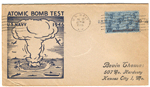
Postal Cover issued on USS Pilotfish (SS 386) at Operation Crossroads Nuclear Test Abel.
Pilotfish was commissioned in the United States Navy for three years, two months, and nine days.  During that time the submarine served six war patrols, earning five battle stars in World War II, and participated in the nuclear bomb testing in the Bikini Atoll.

Author: Allison Hiblong

Labels: , , , , ,

Monday, August 17, 2015

USS Archerfish (SS 311)

"Submarine Honor Guard"

USS Archerfish (SS 311)

Archerfish was among the twelve submarines that served as an honor guard on September 2, 1945, for the formal surrender of the Empire of Japan ending World War II.


Archerfish was a Balao-class submarine built in Portsmouth Naval Shipyard, Kittery, Maine.  Her keel was laid on January 22, 1943, launched on May 28, 1943, and commissioned into the United State Navy on September 4, 1943.  From the day the keel was laid it took ten months and seven days to join the Pacific fleet.

USS Archerfish (SS 311) launched at Portsmouth Navy Yard, May 28, 1943.  Photograph courtesy of navsource.org.
She earned seven battle stars during her World War II service.  The maiden patrol began on December 23, 1943.  The areas of patrols included Formosa, Palau Islands, Bonin Islands, Iwo Jima, Tokyo Bay, and South China Sea off Hong Kong.  Archerfish rescued downed aviator, Ensign John B. Anderson, after a strike against Iwo Jima.

USS Archerfish (SS 311) World War II battle flag.  Photograph courtesy of navsource.org
The primary mission of Archerfish's fifth war patrol was lifeguard service for the first B-29 Superfortress strikes against Tokyo.  November 28, 1944, no air raids were launched that day, so the submarine roamed the waters near Tokyo Bay.  That evening, Archerfish discovered a large Japanese aircraft carrier screened by three destroyers.  Commander Joseph F. Enright decided to attack the carrier while submerged. Six torpedoes were fired upon the ship and successfully sunk the ship.  It was not until after the war that the United States learned that the target was Shinano, the biggest aircraft carrier that served in World War II.  Archerfish received the Presidential Unit Citation, and Commander Enright received the Navy Cross.  To this day, Shinano is the largest warship to be sunk by a submarine.

"For extraordinary heroism in action...against enemy Japanese combatant units in restricted waters of the Pacific.  ...the Archerfish (SS 311) culminated a dogged six and one-half-hour pursuit by closing her high speed target, daringly penetrated the strong destroyer escort screen, and struck fiercely at a large Japanese aircraft carrier Shinano with all six of her torpedoes finding their mark to sink this extremely vital enemy ship. ...the Archerfish skillfully evaded her attackers by deep submergence and returned to port in safety.  Handled with superb seamanship, she responded gallantly to the fighting determination of the officers and men and dealt a fatal blow to one of the enemy's major Fleet units."  Citation for the Presidential Unit Citation for the President, James Forrestal Secretary of the Navy.

Archerfish was on lifeguard duty for B-29 bomber raids in Tokyo when hostilities came to an end August 15, 1945.  She was invited to the surrender ceremony and was present when the Japanese Government signed the instrument of surrender.


After World War II, Archerfish returned to the United States and reported to Mare Island Naval Shipyard.  She was decommissioned June 12, 1946.  Archerfish was recommissioned on March 7, 1952, but a fire occurred aboard the boat during her shakedown.  The submarine had to be repaired, and joined the Atlantic fleet in July 1952.  During her time in the Atlantic she operated out of Key West, Florida, visiting Santiago, Guantanamo Bay, Port-Au-Prince, San Juan, and Trinidad.  She was then decommissioned for a second time on October 21, 1955.

Bow view of USS Balao (SS 285) and USS Archerfish (SS 311) for the movie "Operation Petticoat" in 1959.  Photograph courtesy of Tommy Trampp.
Archerfish was commissioned for a third time into the United States Navy on August 1, 1957.  In 1959, she was portrayed as USS Sea Tiger in the Hollywood movie "Operation Petticoat" for underwater and distance scenes and shots.  In October of 1959, Archerfish was used for establishing feasibility of deep submarine escape.  October 2nd Commander George F. Bond and Chief Engineman Cyril Tuckfield safely completed a 52-second, 302 foot buoyant ascent from the boat's forward escape trunk.  Both men received the Legion of Merit in 1960 for this escape test.

Archerfish post 1957.  Photograph courtesy of navsource.org.
In 1960, Archerfish was reclassified as an auxiliary submarine, (AGSS 311), to participate in Operation "Sea Scan."  This scientific study used a team of civilian scientists to study the marine weather conditions, water composition, ocean depths, and temperature ranges.  Through 1968, she conducted various research assignments.  

Commemorative post mark honoring Archerfish (AGSS 311) January 26, 1961. 
Archerfish's third and final decommission occurred on May 1, 1968.  On October 19, 1968, she was used as a target and sunk by a torpedo from the submarine USS Snook (SSN-592).

Archerfish hit by a MK-14-5 torpedo.  Photograph courtesy of ussarcherfish.com.
The submarine Archerfish (SS 311) had a long and colorful history.  She served the United States Navy for three commissioned eras that spanned 25 years.  Her active service equaled 16 years, 11 months, and 22 days.  She earned seven battle stars for World War II service, was featured in a Hollywood movie, participated in scientific studies, and finally met her fate as a target.

Author: Allison Hiblong

Labels: , , , , , , , , , , , ,